


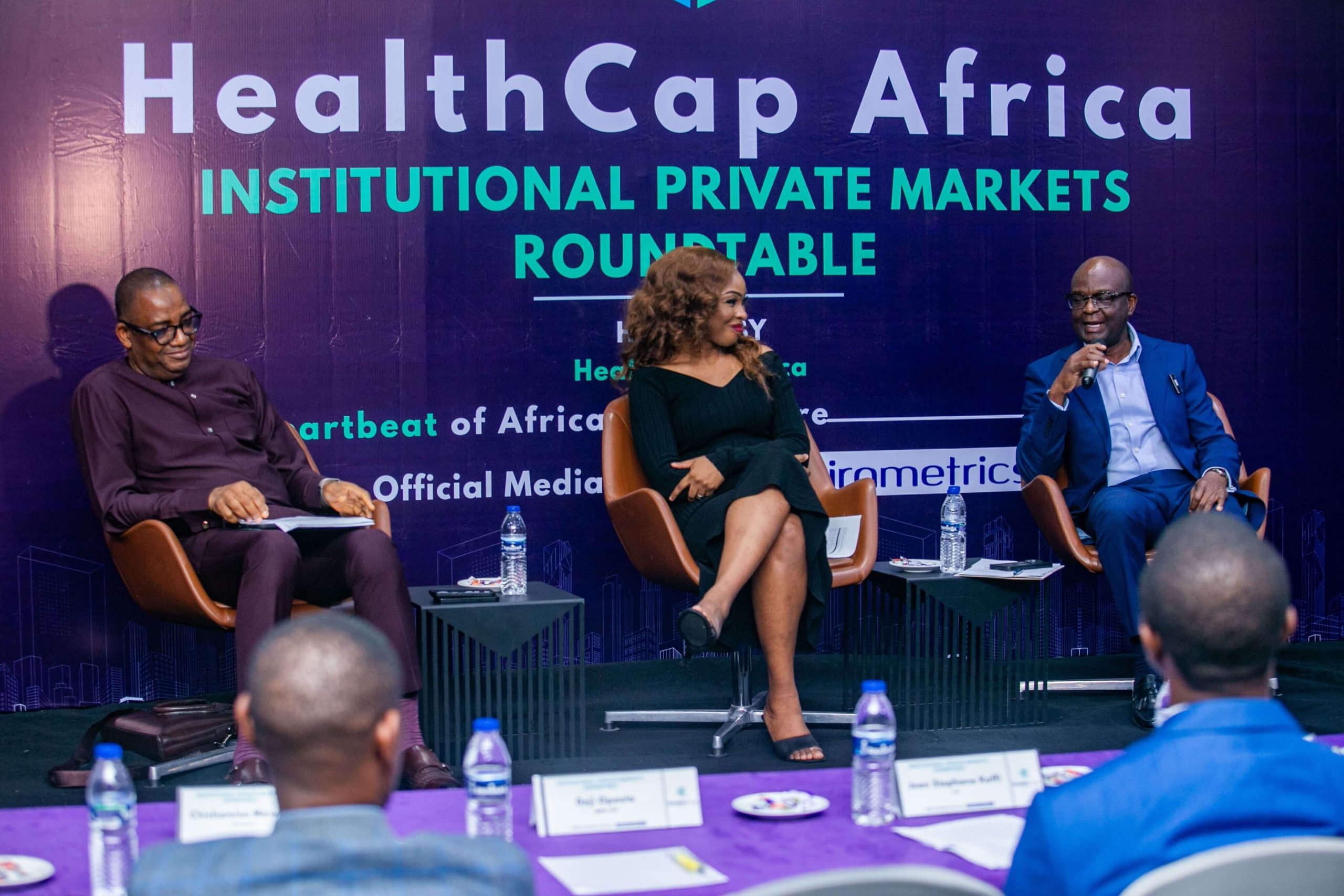
Nigeria’s healthcare sector needs investment, but attracting pension capital requires more than demonstrating demand for hospitals, diagnostics or medical services. Investors need credible revenue models, clear governance and structures that protect retirement savings. A recent HealthCap Africa roundtable in Lagos brought those requirements into focus.
The Private Markets & Healthcare Roundtable, held on 9 September under the theme “Healthcare as an Asset Class”, brought together pension fund representatives, regulators, development finance institutions and healthcare businesses. According to HealthCap Africa, the pension institutions represented collectively managed more than US$5 billion in assets.
That figure describes the institutions’ combined assets under management. It does not represent money allocated or pledged to healthcare. In written clarification to AfricaBusiness.com, HealthCap Africa confirmed that no formal investment commitments were made at the event.
The distinction defines the challenge ahead: turning institutional interest into investment proposals that can withstand scrutiny, secure approval and finance services patients can use.
From a sector opportunity to an investment proposition
The discussion was chaired by Deji Alli, Founder and Chairman of ARM, and co-chaired by Abu Jimoh, Founder and Group CEO of TrustBanc Financial Group. HealthCap Africa reported participation from representatives of Nigeria’s Securities and Exchange Commission, the National Pension Commission, Africa Finance Corporation, the International Finance Corporation and the World Bank, alongside investment managers and healthcare organisations.
The organiser framed the meeting around the need for more sustainable domestic healthcare financing as external assistance becomes less dependable. Its proposed approach brings government funding, philanthropy, development finance and private capital into complementary roles.
For pension investors, however, the social importance of healthcare is only the starting point. The practical question is how a particular investment generates returns, when those returns become available and what happens if performance falls short.
A hospital with established operations presents a different proposition from a facility under construction. A diagnostic network with recurring contracts differs from an early-stage technology business still testing its product. Grouping all these opportunities under healthcare can obscure important differences in risk, cash flow and investment duration.

Protecting retirement savings remains central
HealthCap Africa said the discussion emphasised transparent governance, appropriate risk allocation, credible revenue models and investor protections. These requirements matter because pension assets are held to support beneficiaries’ retirement needs.
Nigeria’s National Pension Commission publishes the framework governing pension investment, including its revised investment regulation and subsequent addendum. Any proposed healthcare vehicle would need to be assessed against the applicable requirements; participation by regulators in a discussion should not be interpreted as approval of a particular product. [1]
For an investment committee, the assessment would extend beyond the headline return. It would need to consider the manager’s experience, the reliability of valuations, the quality of reporting, fees, liquidity and potential conflicts of interest.
The practical implication is that healthcare promoters need to explain both the operating business and the investment structure. A compelling account of unmet medical need cannot replace evidence about the use of capital or the route through which investors may recover it.
Who pays for the care?
A central question for any healthcare investment is the source and reliability of revenue. Patient demand does not automatically translate into cash available to pay staff, maintain equipment and service debt.
As a matter of investment analysis, a proposed facility should identify who is expected to pay: individual patients, health insurers, employers, government purchasers or a combination of these. It should also explain payment terms and what happens when collections are delayed.
That distinction becomes particularly important when a project aims to serve lower-income patients. A large population needing treatment may still struggle to afford it. Investment plans therefore need to show how access and financial sustainability will work together, including any contracted payments or subsidies on which the model depends.
Investors would also need to examine operating assumptions. These include how quickly the facility can attract patients, recruit qualified staff and generate sufficient income to cover its recurring costs. Construction completion is one milestone; establishing a sustainable clinical operation is another.
What a fund-of-funds approach could offer
One structure discussed at the roundtable was a fund of funds: a vehicle that invests in several underlying investment funds rather than selecting every operating company directly.
According to HealthCap Africa’s follow-up response, Africa Finance Corporation indicated a willingness to share its experience developing such a structure. The organiser presented this as a possible reference for institutions exploring venture and private-market investments, rather than an announced healthcare allocation.
In principle, a fund of funds can distribute exposure across managers and portfolios while giving investors access to specialist expertise. For healthcare, that expertise could help assess businesses with different operating models and stages of development.
The structure also introduces additional considerations. Investors need visibility into underlying holdings, overlapping exposures, management fees and the timing of distributions. Diversification can spread risk, but it does not eliminate losses or make long-term investments readily saleable.
The relevant test is therefore whether a proposed vehicle improves the quality of investment selection and oversight sufficiently to justify its cost and complexity. The structure alone cannot make every underlying opportunity suitable for pension capital.
Matching capital to the stage of development
Another theme was the need to match investors with the risks they are equipped to take. According to the organiser’s account, Dr Mories Atoki, CEO of ABC Health, called for more early-stage investment and better alignment between projects and investors.
This raises a useful distinction between developing a business and financing an established operation. An early-stage healthcare company may still need to demonstrate demand, build a management team and establish reliable operating processes. A mature provider may instead require capital to expand a proven service.
Those stages can call for different funding arrangements. As a general structuring option, specialist investors or development institutions could support earlier phases before a project seeks broader institutional participation. Such arrangements would need to define who bears each risk and how that risk changes as the business develops.
No specific staged-financing arrangement was announced at the roundtable. The value of the discussion lies in identifying what future proposals need to resolve, rather than suggesting that an investable structure is already in place.
A hospital example, with financial details still missing
HealthCap Africa cited a 250-bed multi-specialty tertiary hospital project in Gateway, Abeokuta, discussed by Humphrey Oriakhi of PAC Capital. The organiser described it as an example of healthcare infrastructure financed with private capital.
However, the follow-up response did not provide an investment amount, financing terms, repayment structure or details of investor protections. AfricaBusiness.com therefore cannot assess the project as a worked example of a pension-suitable transaction.
For other project sponsors, that information gap illustrates what makes a financing case useful. Beyond the size of a hospital, prospective investors need to understand the ownership structure, sources of funding, expected revenue and allocation of construction and operating risks.
Evidence from completed transactions could help future discussions move towards practical investment design. It would allow institutions to examine what worked, which assumptions proved difficult and whether the approach could be applied elsewhere.
Private investment and public provision have different roles
Mobilising domestic institutional capital could expand the range of financing available to healthcare businesses. It cannot, by itself, answer every question about access to care or replace funding for services without a viable commercial revenue model.
The roundtable’s emphasis on complementary sources of funding is therefore important. Public budgets, grants, development finance and commercial investment operate with different objectives and repayment expectations. A credible financing strategy needs to identify which source fits which service.
For healthcare operators, this means making the investment case specific. The strongest proposals will explain the patients they intend to serve, how care will be paid for, the capital required and the safeguards around both clinical delivery and financial management.
For pension institutions, the next step is equally concrete: assess defined opportunities against beneficiaries’ interests, investment mandates and regulatory requirements.
The Lagos discussion did not produce a healthcare funding commitment. It identified work needed before one becomes possible. Progress will be measured by transparent investment products, disclosed transaction terms and functioning healthcare services, rather than the combined asset base of institutions attending a meeting.
Sources
[1] National Pension Commission (PenCom).
Investment regulations and related updates.
HealthCap Africa’s press release, dated 15 September 2026, and written clarifications supplied to AfricaBusiness.com through Wimbart on 17 September 2026.
Event participation, institutional assets under management and the hospital example are attributed to HealthCap Africa. The discussion of investment structures and due diligence is editorial analysis, not a description of an agreed transaction.