


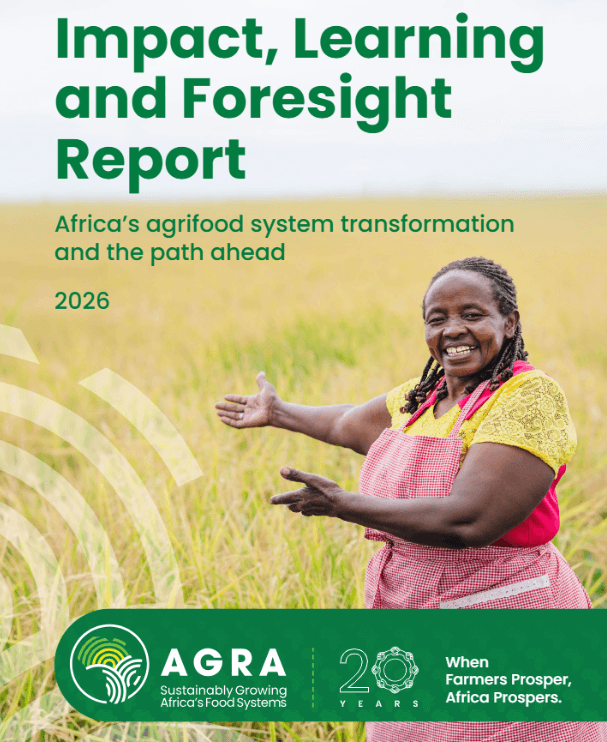
Africa has made substantial gains in agricultural production over the past two decades, but a persistent gap between output and farmer prosperity shows that the continent’s food systems have yet to achieve full transformation, according to a new 20-year assessment released by AGRA.
Africa’s agricultural output has roughly doubled in real terms over the past 20 years, farmer incomes have doubled and cereal yields have increased by around 40%, according to AGRA’s new Impact, Learning and Foresight Report 2026.
Yet the report argues that higher production alone has not been enough to build a sufficiently productive, profitable and resilient agricultural economy.
Released in Nairobi on August 31 as AGRA marks its 20th anniversary, the assessment warns that Africa remains off track to meet the agricultural transformation ambitions associated with the Kampala Declaration and the third phase of the Comprehensive Africa Agriculture Development Programme, or CAADP.
One of the most significant challenges is finance.
AGRA estimates an annual financing gap of around $180 billion across Africa’s agrifood sector, including approximately $65 billion for small and medium-sized agribusinesses.
The scale of that gap illustrates why the next stage of Africa’s agricultural development will require substantially more than increasing production at farm level. It will depend on whether farmers can connect to finance, processing, logistics, markets and value chains capable of turning agricultural output into sustainable income.
Production growth has not eliminated the productivity gap
The report presents a mixed picture of African agriculture.
On one hand, the continent has built significant agricultural capacity since the early 2000s. Farm output has approximately doubled in real terms, while cereal yields have increased by about 40%.
AGRA also says agriculture’s Gross Value Added growth rose from around 2.3% to almost 4%.
But significant productivity differences remain between Africa and the global economy.
Agricultural gross value added per worker in Africa is approximately $1,500, compared with a global average of around $4,300, according to the report.
The maize productivity gap is similarly substantial. Average maize yields are around 1.6 tonnes per hectare in Africa, compared with approximately 4 tonnes per hectare globally.
Irrigation remains another structural constraint. Only around 3% of cropland in sub-Saharan Africa is irrigated, compared with roughly 40% in Asia.
These differences matter not only for food security but also for the competitiveness of African agribusiness.
Low or volatile farm productivity can raise the cost of raw materials for food processors, increase dependence on imports and make it harder for businesses to develop reliable agricultural supply chains.
From production to farmer prosperity
The central argument of the AGRA assessment is that the success of African agriculture should increasingly be measured by what farmers earn rather than simply by how much they produce.
“Twenty years of evidence show that Africa’s agrifood sector can move when the conditions are right,” AGRA President Alice Ruhweza said in announcing the findings.
She said the next task is to translate progress into income, resilience, dignity and opportunity for farmers through closer collaboration between governments, farmers, businesses, finance providers, researchers and development partners.
That shift has significant implications for policymakers and investors.
Agriculture remains central to the continent’s economy. According to AGRA, approximately 64% of African livelihoods depend on agrifood systems, which generate nearly one-third of GDP.
At the same time, around two-thirds of food produced in Africa is destined for urban markets.
Continued urbanisation therefore represents both a challenge and an opportunity.
Rising urban demand could support larger markets for African farmers, food processors, logistics companies and retailers. But capturing that opportunity will require stronger connections between production areas and consumers, as well as investment in transport, storage, cold chains, processing and distribution.
Three traps holding back African agriculture
AGRA identifies three interconnected constraints that it describes as the productivity trap, value trap and capability trap.
The productivity trap refers to agricultural output that remains too low, variable or vulnerable to climate shocks, land pressure and other disruptions.
The value trap emerges when higher production does not translate into stronger farmer incomes, viable businesses, processing capacity, jobs or trade.
The capability trap concerns the institutions, finance, policies, data, skills and accountability mechanisms needed to turn agricultural strategies into sustained results.
The report argues that addressing one problem without the others will not be sufficient.
Higher yields, for example, may provide limited benefits to farmers if they cannot obtain competitive prices, store their harvest, access processors or reach profitable markets.
Similarly, building processing capacity without reliable agricultural production can leave businesses struggling to secure sufficient raw materials.
This is why AGRA is calling for a more integrated approach linking farmers with finance, infrastructure, markets, science and industry.
Agriculture as an investment sector
The report also makes a broader economic argument: African agriculture needs to be viewed as an investable industry rather than primarily as a development challenge.
The estimated $180 billion annual financing gap highlights the potential scale of opportunities for commercial banks, development finance institutions, private equity, impact investors, insurers, fintech companies and other sources of capital.
Small and medium-sized agribusinesses are particularly important because they often connect smallholder farmers to larger commercial markets.
These companies operate across areas including seed distribution, agricultural inputs, mechanisation, food processing, logistics, storage, digital agriculture and market aggregation.
However, many continue to face difficulties accessing affordable long-term finance.
Closing the investment gap will consequently require mechanisms capable of reducing risk and attracting more private capital alongside public and development finance.
Climate and land pressures raise the stakes
The investment challenge is becoming more urgent as environmental pressure increases.
AGRA estimates that around 65% of Africa’s productive land is degraded, while desertification threatens approximately 45% of the continent’s total land area.
Climate volatility creates additional risks for farmers and agricultural businesses, particularly in areas dependent on rain-fed agriculture.
The report therefore connects agricultural productivity with resilience, including better seed systems, soil health, irrigation, climate-smart farming practices and improved agricultural advisory services.
For investors, resilience is increasingly an economic consideration rather than solely an environmental one. Agricultural businesses exposed to drought, unpredictable rainfall or deteriorating soils face greater supply and pricing risks across the value chain.
What AGRA says has changed over 20 years
AGRA presents its own role as one component of a much broader transformation involving African governments, farmers, researchers, businesses, financiers and development organisations.
Over the past two decades, AGRA and its partners say they have supported 118 seed companies and more than 650 improved seed varieties.
They have also helped develop networks of more than 25,000 agro-dealers and 33,000 community extensionists, trained around five million farmers in soil-health and climate-smart agricultural practices, and worked with nearly 800 scientists.
AGRA says its work has also helped leverage approximately $691 million for national agricultural investment plans.
The organisation stresses that these results should be understood as contributions to a much larger continental effort rather than evidence that any single institution is responsible for Africa’s agricultural progress.
Kigali puts investment at the centre
The report comes as policymakers, investors, businesses and agricultural organisations gather in Rwanda for the Africa Food Systems Forum 2026, taking place at the Kigali Convention Centre from September 1 to 4 following pre-summit activities on August 31.
This year’s theme — “Investing in Africa’s Agri-Food Systems: Nourishing Nations, Growing Jobs, Building Resilience” — puts financing and commercial development at the centre of the discussion.
The forum is expected to bring together more than 5,000 participants from over 50 countries, with investment and finance, food security, climate resilience, youth and digital innovation, and trade and value chains among its principal themes.
The timing is significant.
Africa has demonstrated that agricultural output and yields can increase. The more difficult task is ensuring that productivity gains flow through the wider economy — generating profitable farms, competitive agribusinesses, processing capacity, jobs and stronger regional trade.
As AGRA Board Chair Hailemariam Dessalegn said in presenting the report, the question for the next decade is no longer simply how much Africa can produce, but whether the systems surrounding farmers enable them to prosper.
The answer will depend increasingly on whether governments and development institutions can create the conditions needed for private capital, African businesses and farmers themselves to participate in the next stage of the continent’s agricultural transformation.
Sources and Information
- AGRA. Impact, Learning and Foresight Report 2026: Africa’s agrifood system transformation and the path ahead.
Official report: https://agra.org/foresight-report-2026/ - AGRA. Africa’s Food Systems Must Be Judged by What Farmers Earn, AGRA’s 20-Year Review Concludes. 31 August 2026.
Official press release: https://agra.org/ - Africa Food Systems Forum. AFS Forum 2026, Kigali, Rwanda.
Official event information: https://afs-forum.org/ - AGRA. Official website and institutional information. https://agra.org/