


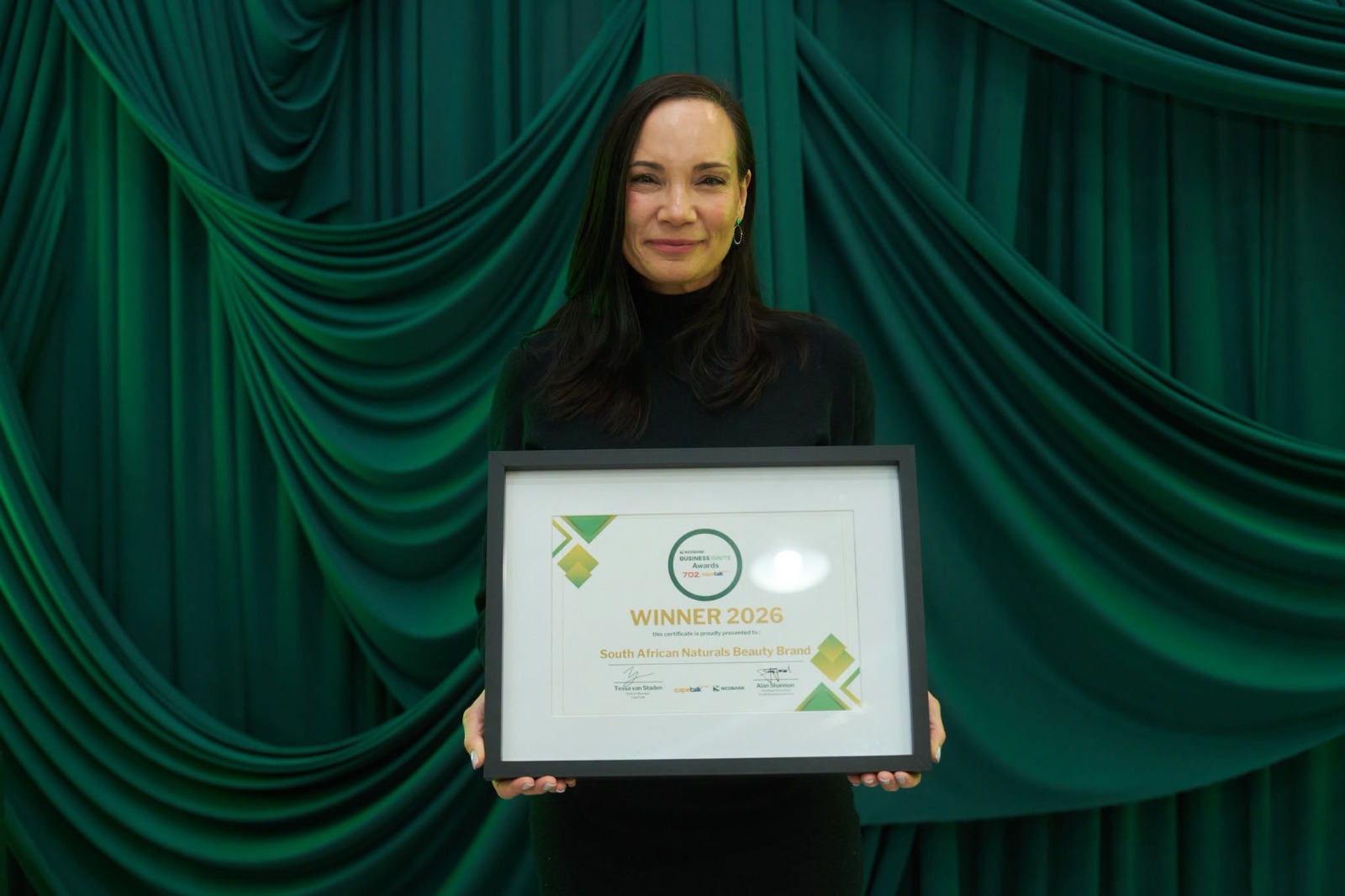
Around half of the South African company’s sales now come through online channels. Founder Tanya du Bois is combining e-commerce, retail, exports and bespoke product development to drive its next phase of growth.
For many small consumer brands, e-commerce is treated as an additional sales channel. At Naturals Beauty, it has become part of the operating model.
Around 50% of the South African skincare company’s sales now come through its own website and third-party marketplaces, according to founder Tanya du Bois. The remaining half is generated through physical retail, wholesale, exports and bespoke product-development work.
That balance matters for a founder-led manufacturer trying to grow without external equity investment. Online sales give the Cape Town business national reach and direct customer relationships, while retail and export partners broaden distribution. A newer product-development arm adds a business-to-business revenue stream that does not depend solely on selling the Naturals Beauty label.
The company’s latest public milestone came in July, when du Bois and Naturals Beauty won the 2026 Nedbank Business Ignite competition with CapeTalk. CapeTalk publicly confirmed the win. [1]
The award includes R200,000 in funding, which du Bois says will be used primarily to update the packaging of the company’s teen skincare range.
A family need becomes a product business
Naturals Beauty began in 2008 after du Bois’s young son was diagnosed with autism. Following advice to examine the everyday products used by the family, she started reading labels and looking for personal-care alternatives that met her preferences for effective, affordable and readily available products.
Unable to find what she wanted locally, du Bois began experimenting with lotions, washes and body butters at home. The diagnosis is part of the founder’s account of what prompted her search; it is not evidence that personal-care products cause, prevent or treat autism.
Interest from other mothers in her support community turned the small batches into early orders. Du Bois had no formal background in cosmetic science, so moving beyond home production required specialist support.
She says it took close to a year to find a cosmetic chemist who understood the brief and was willing to work with a small, values-led brand. That relationship helped transform an informal side business into a structured product company.

Revenue rises 80% in three years
Naturals Beauty remains fully founder-owned and has not taken external equity investment, du Bois told AfricaBusiness.com. Sales revenue has largely financed operations and expansion, with earnings repeatedly reinvested in product development, packaging and the wider range.
South Africa’s Small Enterprise Development Agency has supported several smaller packaging-development projects, she added, but the company’s day-to-day operations and long-term growth have primarily been funded internally.
The company says annual revenue increased from approximately R1.41 million in its 2023 financial year to R2.54 million in 2026. That represents growth of about 80% over three years. Gross profit rose by approximately 73% over the same period.
The product range has expanded from three products at launch to more than 70 stock-keeping units. The company currently operates with four in-house employees and a network of specialist partners covering manufacturing, formulation, design and marketing.
Du Bois puts current production at about 140 litres of finished bulk product a month, although output varies with demand and product mix.
Distribution now includes more than 40 physical retail locations in South Africa, the company’s online store, other e-commerce platforms and three active export markets. Naturals Beauty also maintains a public stockist directory. [2]


Cash flow remains the scaling constraint
The company’s growth figures sit alongside a common manufacturing challenge: expenditure comes well before revenue.
Packaging, ingredients and production generally have to be paid for before the finished goods are sold, while retailers may settle invoices on extended terms. Minimum order quantities can magnify that pressure by forcing a small brand to commit cash before demand is certain.
Du Bois also identifies higher raw-material and packaging costs, regulatory requirements and the expense of building consumer awareness through digital advertising as barriers to scale.
Local manufacturers must absorb those costs while competing with international groups that have larger marketing and distribution budgets.
This is why the R200,000 award has a specific operational purpose. Rather than funding a broad promotional campaign, it is earmarked mainly for packaging improvements to an existing teen range.
Du Bois says the company previously financed another range’s packaging upgrade itself, demonstrating how quickly such a project can consume working capital.
Digital channels account for half of sales
Naturals Beauty’s online share shows how e-commerce can narrow the distribution gap for an independent manufacturer.
The company uses digital channels to sell nationally, explain ingredients and product positioning, introduce new products and maintain relationships with customers beyond its current retail footprint. Its official website operates as an active online store with products organised across skincare and family categories. [3]
Digital marketing also gives the business a more measurable route to awareness than relying only on additional store listings.
Yet the model is not purely direct-to-consumer. Du Bois’s figures place e-commerce alongside retail, wholesale, exports and product-development contracts, creating a diversified channel mix rather than a single growth engine.
Bespoke development adds a second growth platform
One of the company’s most important strategic shifts is its expansion into bespoke and private-label product development.
The service can cover product concepts, formulation, ingredient and fragrance development, packaging coordination, compliance and preparation of a complete range for market.
The proposition turns expertise accumulated over 18 years into a service for other businesses. It also opens a potentially scalable revenue stream that is less dependent on the performance of Naturals Beauty’s own consumer products.
A current example is a range being developed with Cape Town wine estate Klein Constantia. The planned body-care, skincare and men’s-grooming products are expected to use ingredients and by-products associated with winemaking, including grape seed extract and grape-derived exfoliating material.
The parties were targeting a November 2026 launch when the information was supplied.
“I love working with brands to find what makes them unique and then turning that story into a product. Every brand has its own identity, its own ingredients and its own story to tell,” du Bois says.
A selective route into African markets
Naturals Beauty began exporting to Namibia in 2018, Uganda in 2022 and Zambia in 2024, according to du Bois.
Its immediate priority is to strengthen those existing relationships while assessing opportunities in Kenya and Senegal.
The measured approach reflects the realities of cross-border consumer expansion. A beauty brand must manage local demand, distribution partners, compliance, logistics and marketing costs in each market. For a self-funded company, sequencing those commitments is as important as identifying potential customers.
Over the next three to five years, du Bois wants to expand the South African retail footprint, grow online sales, enter additional African markets and increase production capacity.
She also wants Naturals Beauty to become a recognised development and manufacturing partner for businesses seeking locally made ranges.
The larger lesson is not simply that a kitchen-table idea became a brand. Naturals Beauty’s next stage depends on combining channels and capabilities: direct digital sales, selective retail, export partnerships and product development for other companies.
For a small African manufacturer operating without outside equity, that mix may prove more durable than chasing scale through shelves alone.
Financial, production, channel-share and expansion figures in this article were provided by Naturals Beauty through written answers from founder Tanya du Bois. They have not been independently audited by AfricaBusiness.com.
Sources
[1] CapeTalk. Announcement of Tanya du Bois and Naturals Beauty as the 2026 Nedbank Business Ignite winner, 15 July 2026.
[2] Naturals Beauty. Stockists, accessed 20 September 2026.
[3] Naturals Beauty. Official online store, accessed 20 September 2026.