
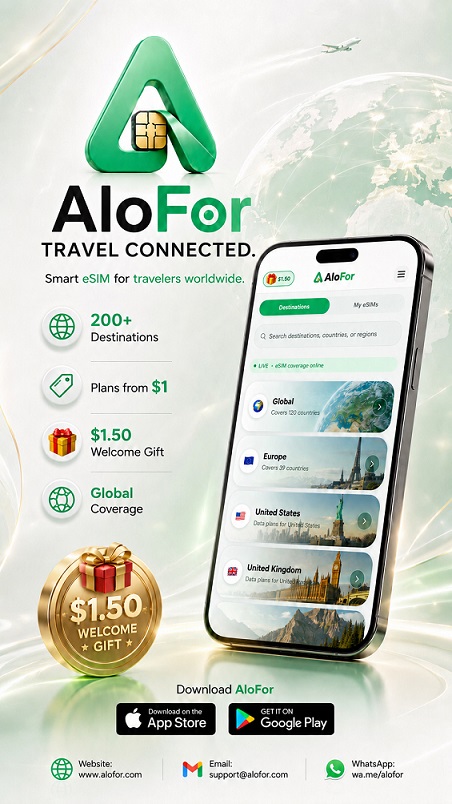
AloFor travel eSIM platform. Image courtesy of AloFor.
International mobile connectivity used to revolve around a familiar set of choices: activate an operator roaming package before departure, accept pay-as-you-go roaming charges, or buy a physical SIM card after landing.
The rapid expansion of eSIM is adding another layer to that market. Travellers can increasingly select, purchase and install mobile-data connectivity digitally before reaching their destination, changing not only the technology inside the phone but also the way international connectivity is distributed and sold.
For African travellers and businesses, the implications extend beyond convenience. Business travel, tourism, diaspora movement, international study and remote work all depend increasingly on immediate access to mobile data, while airlines, banks, fintechs and travel platforms are gaining opportunities to embed connectivity directly into customer journeys.
eSIM is moving from niche technology towards scale
The underlying market is expanding quickly.
GSMA data cited in material supplied for this article put global eSIM smartphone penetration at approximately 5% at the end of 2025, with penetration expected to reach around 10% by the end of 2026 and double again during 2027.[1]
The GSMA also expects smartphone connections using eSIM to outnumber those relying on traditional removable SIM cards by 2030.[1]
International travel is emerging as one of the technology’s most visible consumer applications. According to GSMA Intelligence’s 2025 Global Consumer Survey, 12% of consumers who had travelled internationally during the previous 12 months used an eSIM while abroad. More than 70% of those users obtained their travel eSIM through a mobile operator.[2]
That last point is important. Travel eSIM is not simply a contest between mobile operators and technology startups. Operators remain central to the connectivity chain because they control the underlying networks and many of the wholesale and roaming relationships on which digital travel products depend.
What is changing is the distribution layer around that connectivity.
How the travel eSIM model works
For a traveller, the process can appear simple: choose a destination, compare packages, buy a plan, install an eSIM profile and activate it when needed.
Behind that experience sits a more complex supply chain involving mobile operators, roaming and wholesale relationships, connectivity aggregators, digital platforms and customer-support systems.
Consumer-facing travel eSIM companies package this underlying network access into destination-specific, regional or global products. Their competitive challenge is therefore not only to obtain coverage, but to make plan selection, pricing, activation and troubleshooting simple enough for a traveller who may need connectivity immediately after arriving in an unfamiliar country.
That makes reliability particularly important.
A failed entertainment app is inconvenient. A failed mobile-data connection after an international flight can prevent a traveller from accessing maps, ride-hailing services, banking, messaging, hotel details or work systems.
For travel eSIM providers, customer support therefore becomes part of the core product rather than an after-sales function.
AloFor offers an early-stage case study
One smaller company competing in this increasingly crowded market is AloFor S.R.L., a travel-tech platform registered and developed in Romania by Lebanese entrepreneur Ahmad Khodr.
According to company information supplied to AfricaBusiness.com, AloFor currently offers mobile-data eSIM plans covering more than 200 destinations through country, regional and global packages. Selected plans start from USD 1, while eligible new users may receive a USD 1.50 credit towards a first purchase. The service is available through the web, Apple App Store and Google Play.
AloFor says it has passed 1,000 new users. That figure is company-reported rather than independently audited, and a more detailed internal dataset provided by the company shows the business remains at an early commercial stage.
As of 27 August 2026, AloFor reported 159 successfully fulfilled paid transactions across 66 distinct purchasing users.
Of those transactions, four — involving four distinct users — were for an African destination, Egypt. This represented approximately 2.52% of fulfilled transactions and 6.06% of distinct purchasers in the dataset.
The company has been careful not to infer more from those numbers than the data supports. AloFor can verify the destination associated with the purchase, but does not currently use signup information to determine the traveller’s country of origin. It therefore cannot claim that those customers were travelling from Africa.
The limited numbers also mean AloFor cannot yet claim material African market traction. Instead, its experience provides an early illustration of some of the opportunities and barriers facing travel eSIM adoption on the continent.
Where could African demand develop?
Egypt is currently the only African destination for which AloFor says it can point to completed paid usage in its internal dataset.
Looking ahead, Khodr identifies Morocco, South Africa and Kenya alongside Egypt as markets with potential because they combine international travel flows with expanding digital-service adoption. He describes these as prospective markets rather than countries where AloFor is claiming meaningful commercial traction today.
The broader opportunity is likely to develop in several segments.
Inbound tourists may value connectivity that works immediately on arrival. Business travellers may prefer predictable data costs and the ability to prepare connectivity before departure. Diaspora travellers frequently move between countries, while students and remote workers may place a premium on remaining connected without replacing their primary physical SIM.
For African businesses, the opportunity is also potentially larger than selling standalone data packages.
Connectivity could become an embedded travel service
Travel eSIM can increasingly be integrated into products that customers already use to organise and pay for international travel.
An airline could offer connectivity alongside a flight booking. A bank or fintech could combine an eSIM with a travel card or foreign-exchange product. Travel insurers, online travel agencies and airport-service providers could also incorporate connectivity as an additional digital service.
Khodr sees this embedded model as a significant long-term opportunity.
“An eSIM can sit naturally beside a flight booking, travel card, insurance product or airport service.”
He stresses that this represents a potential partnership model rather than an announcement of partnerships already secured by AloFor.
For African fintech and travel companies, however, the concept is strategically relevant. A company that already owns a trusted customer relationship may not need to become a telecom operator to incorporate international connectivity into its product experience.
Why adoption will not be uniform across Africa
Travel eSIM also faces practical barriers that differ significantly between African markets.
Khodr identifies eSIM-compatible handset penetration, consumer awareness and trust as some of the most significant obstacles, followed by price sensitivity and uncertainty around device and network compatibility.
That means the availability of an eSIM product does not automatically translate into mass-market adoption.
Consumers need compatible devices. They need to understand that eSIM exists. They need confidence that a plan will activate correctly, work on the expected network and provide the amount of data advertised.
Device affordability is especially relevant in African markets where large segments of consumers remain concentrated in lower-cost smartphones and where the replacement cycle for handsets may be longer than in higher-income economies.
Travel eSIM is therefore more likely to develop unevenly across the continent and to complement traditional mobile services rather than replace them.
When an eSIM is not necessarily the best option
The convenience of digital activation does not mean travel eSIM is always cheaper or more suitable than the alternatives.
According to Khodr, a travel eSIM tends to be particularly useful when a traveller wants instant setup before arrival, predictable data pricing, the ability to keep a primary SIM in place or connectivity across several destinations.
A local SIM may remain more attractive for a long stay, very heavy data consumption or when a traveller needs a local telephone number.
An operator roaming package can also be competitive when the traveller’s existing mobile plan already includes favourable international roaming.
This distinction is important as competition intensifies. The relevant question for travellers is not whether eSIM is technologically newer, but whether the complete package offers better value for a particular journey.
Competition will increasingly be about trust and execution
The travel eSIM market already includes much larger international brands, mobile operators and connectivity providers.
For smaller companies such as AloFor, competing solely on price is unlikely to create a durable advantage.
Khodr argues that the more sustainable differentiators will be operational: simple plan selection, reliable provisioning, transparent pricing, effective localisation and fast support when something goes wrong.
“I do not believe a smaller platform can build a durable business only by being cheaper. The sustainable advantage has to come from the full operational experience.”
That observation applies more broadly to the industry.
As destination coverage becomes easier for competing services to replicate, customer experience, transparency and trust are likely to become more important. A plan advertised at a low price has limited value if compatibility is unclear, network performance disappoints or support is unavailable when activation fails.
What this means for African digital businesses
For Africa, the development of travel eSIM raises strategic questions on both sides of the connectivity market.
Mobile operators can strengthen their own roaming and digital travel offers. Fintechs, banks, airlines and travel companies can consider connectivity as an embedded service. Technology startups can compete in distribution, localisation and customer experience.
At the same time, physical SIMs, local operator packages and conventional roaming will continue to have advantages in particular circumstances.
The shift is therefore less about one technology completely replacing another than about creating more competition over who owns the relationship with an international traveller.
As eSIM penetration rises, connectivity is moving closer to the moment a journey is planned rather than the moment a traveller searches for a SIM card after arrival.
For African businesses, that creates opportunities to integrate mobile connectivity into broader digital products. For consumers, it creates more choice. And for travel eSIM startups, it raises the competitive standard: coverage alone will increasingly be insufficient.
The companies that succeed will need to combine reliable network access with transparent pricing, straightforward activation and support that works when travellers need it most.
Sources and Information
[1] GSMA — eSIM mass market deployment moves from forecast to fact, 1 May 2026
GSMA reporting covers the accelerating penetration of eSIM-enabled smartphones and the expected transition towards eSIM becoming the dominant smartphone SIM format.
GSMA: eSIM mass market deployment moves from forecast to fact
[2] GSMA / GSMA Intelligence — International travel and eSIM adoption
GSMA reporting citing its Global Consumer Survey found that 12% of consumers who had travelled internationally during the previous year used an eSIM abroad, with more than 70% obtaining the travel eSIM through a mobile operator.
GSMA: International travel connectivity and eSIM adoption
[3] AloFor — Company information supplied for editorial review
AloFor supplied company-reported information on destination coverage, pricing, distribution channels, user registrations and fulfilled transactions. Company figures cited in this article are identified as such and should not be interpreted as independently audited market statistics.
AloFor
About Ahmad Khodr
Ahmad Khodr is the Lebanese founder and CEO of AloFor S.R.L., a travel-tech company registered and developed in Romania.