

Built in Ibadan within the Techdella business, startbuddi brings customer management, marketing and everyday operations into one connected workspace. Founder Joanna Okedara-Kalu explains the thinking behind the platform and the commercial questions it still needs to answer.
A small business can have plenty of software and still struggle to keep its work organised. Customer details sit in one application, bookings in another and project updates in a third, while conversations continue through email and WhatsApp. Connecting those records can become a job in itself.
That problem is the starting point for startbuddi, a business operations platform built in Ibadan, Nigeria. According to founder Joanna Okedara-Kalu, the platform is live and usable today, bringing customer management, marketing, work management and other everyday business operations into one connected workspace. Its AI assistant, Chip, already provides assistance across parts of that environment, while the team continues to expand its capabilities.
For Okedara-Kalu, the idea grew out of experience delivering marketing and digital services through Techdella. Working with small businesses exposed a recurring gap between buying software and getting it to function as a coherent part of daily operations.
“Technically, that business has plenty of software. Operationally, it can still be a mess,” she told AfricaBusiness.com in written responses.
The company’s ambition is to reduce that fragmentation. Its next challenge is demonstrating that businesses will adopt the connected workspace, continue using it and pay for the additional capabilities they need.
From digital services to a connected business workspace
According to Okedara-Kalu, development of startbuddi began in Nigeria in 2026. The platform operates within Tech Della Solutions Ltd, the Nigerian company behind the wider Techdella business.
Techdella’s origins are in marketing and digital services. As its team worked with clients, it repeatedly encountered businesses paying for separate tools for customer relationship management, email marketing, bookings, websites and internal operations, while still needing help to connect them.
That experience informed startbuddi’s product direction. Okedara-Kalu describes it as a distinct product with its own brand and application, rather than simply an internal tool for the services business.
The move also forms part of a broader shift at Techdella towards software products. Other products within the organisation include Paycape and Shopinbos.
The startbuddi team is lean, with some functions shared across the wider business. Okedara-Kalu declined to present shared employees as a dedicated startbuddi headcount. Product development, engineering, design, marketing, operations and much of customer support are handled internally.
Techdella also uses startbuddi as a real operating environment. Forms, CRM, bookings and follow-up workflows are among the activities handled through the platform. This gives developers direct experience of operating the product, although internal adoption is different from evidence of results across independent customers.
What is available today
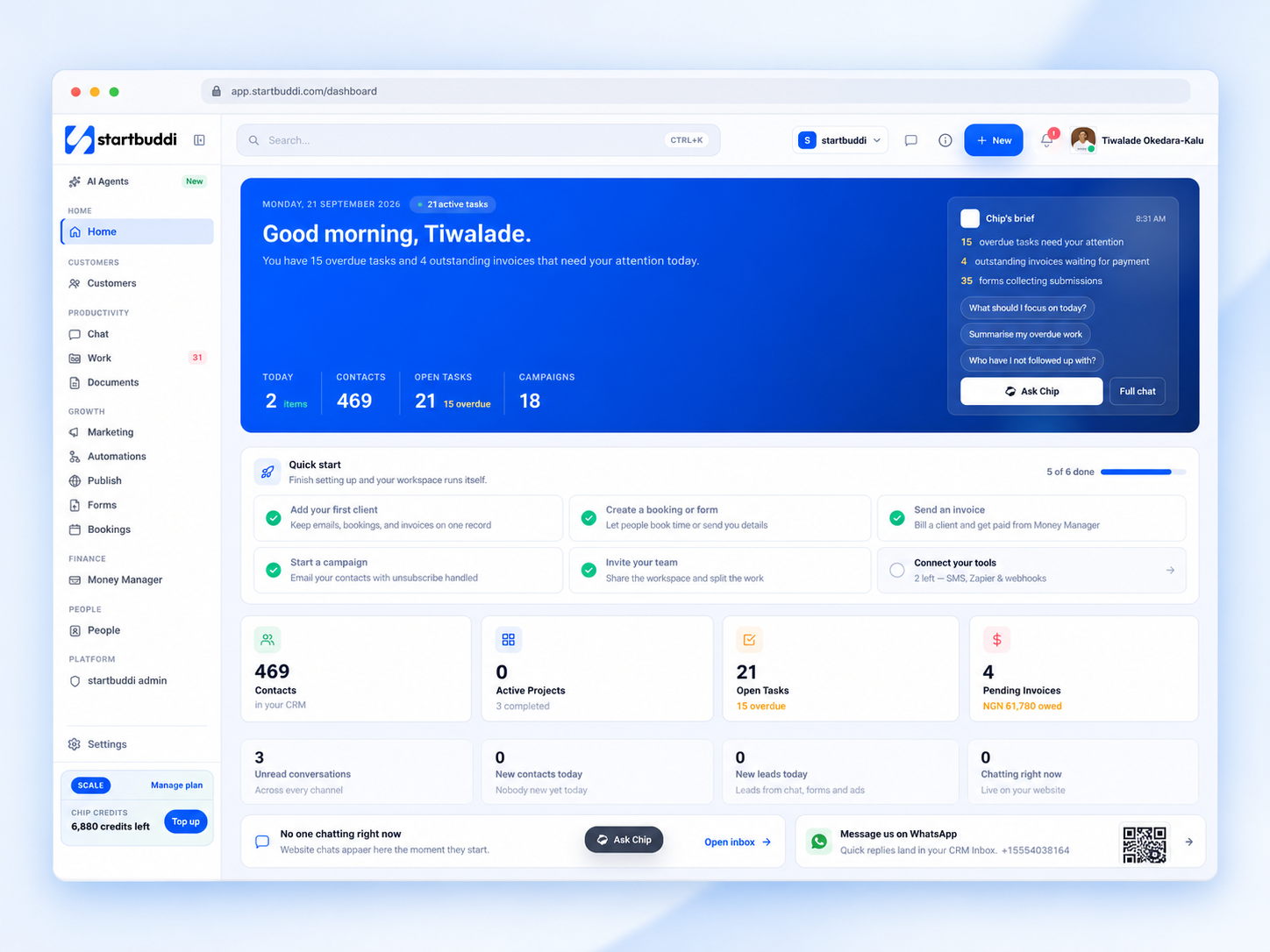
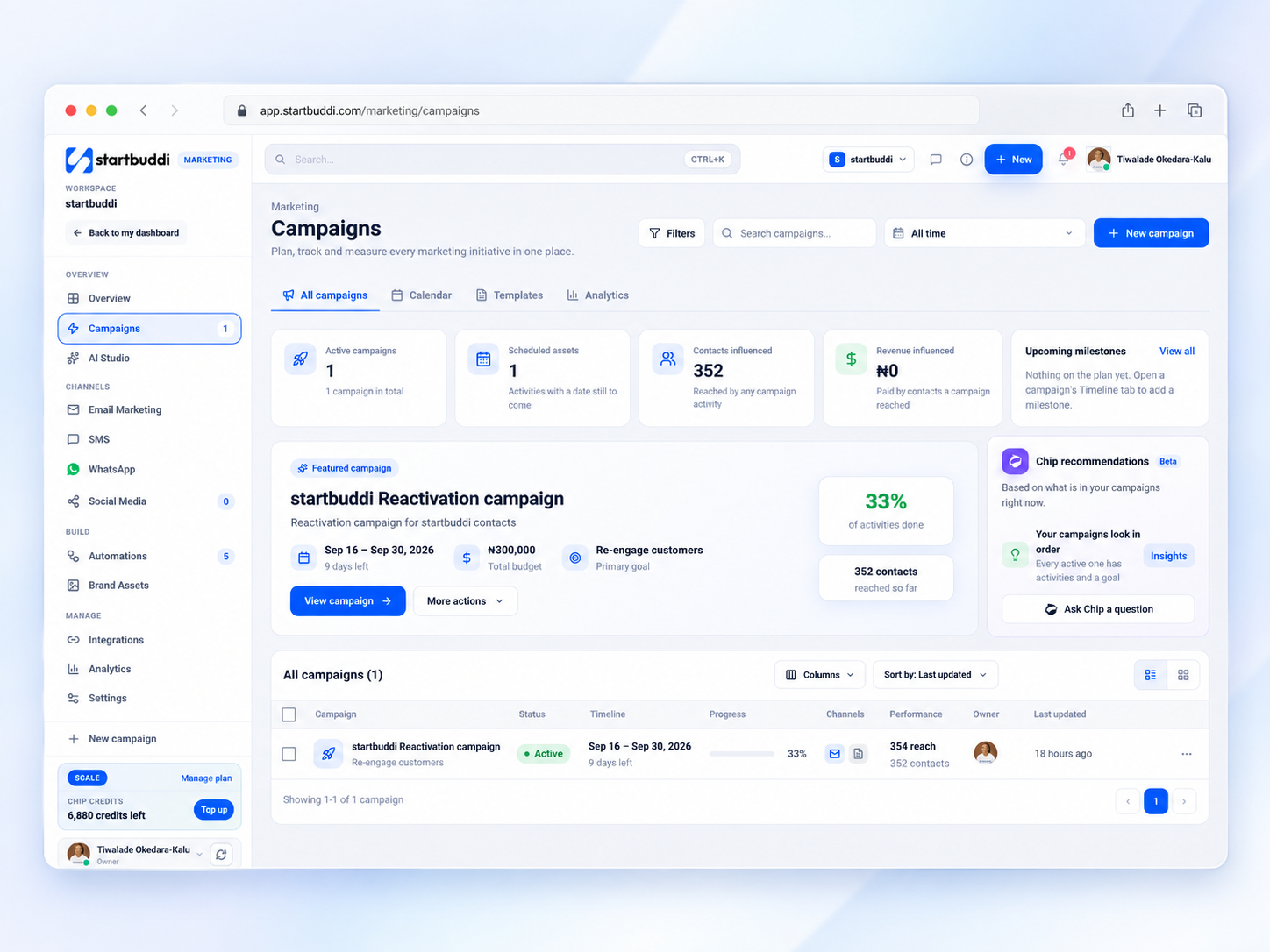
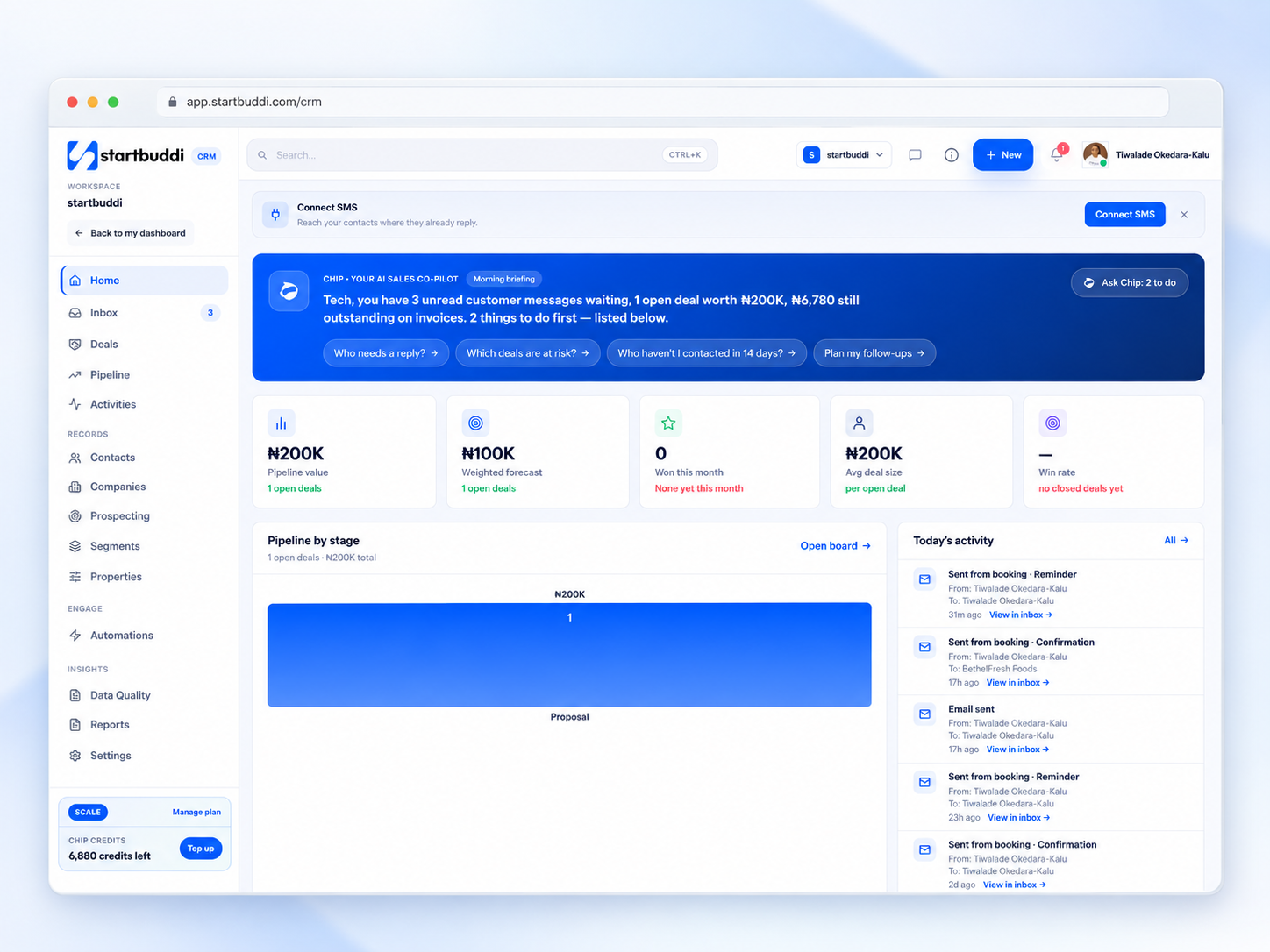
In her clarification to AfricaBusiness.com, Okedara-Kalu identified CRM and customer management, contacts and pipelines, marketing and email campaigns, forms, bookings, projects and tasks, documents, and team collaboration as existing parts of the platform.
Publishing tools, prospecting and lead research, automations and Chip AI assistance are also available, she said. Individual capabilities within these areas continue to evolve.
The intended distinction is that these functions share business context. Customer records, marketing activity, work and other operations are meant to connect within the workspace, with Chip helping users work across that environment.
These descriptions reflect the company’s account of its current product. AfricaBusiness.com has not independently tested the platform.
A free plan with a commercial test ahead
Okedara-Kalu describes startbuddi as bootstrapped. That has influenced decisions about product priorities and spending on infrastructure and AI.
The company has moved from a limited-trial approach towards a permanent free plan with paid upgrades. Businesses can maintain a free workspace; it is not simply an extended trial. More advanced functionality and higher usage are intended to sit within paid plans.
For a platform spanning several business functions, that approach raises an important question: which initial use makes the software valuable enough for a customer to stay?
One business might begin with bookings and customer records. Another might start with project management or marketing. The commercial opportunity depends on whether those initial activities lead to sustained use and, eventually, demand for paid capabilities.
Okedara-Kalu said the team is monitoring activation, conversion from free to paid use, retention and the modules businesses adopt. It also wants to understand whether customers actually replace other tools after moving work into startbuddi.
The company has not provided revenue figures or completed customer studies demonstrating measurable savings. Its proposition therefore remains one to be tested through customer behaviour, rather than established by the breadth of its feature list.
Building around African business practices
Nigeria is startbuddi’s strongest African market at this stage, according to its founder, reflecting the company’s location and existing relationships.
Its ambitions extend beyond Nigeria. However, Okedara-Kalu places more emphasis on accommodating business practices than on announcing a long list of expansion markets.
That includes WhatsApp-led communication, local payment options, different currencies and businesses without dedicated IT or operations teams.
For a small service company, adopting software can require more than learning a new interface. Existing customer conversations, payment arrangements and records must fit into the new workflow. If too much has to change at once, the effort of switching can outweigh the immediate benefit.
WhatsApp, Paystack and Flutterwave are important to startbuddi’s African integration strategy, but their implementation and availability differ. According to Okedara-Kalu, WhatsApp integration is still being improved and expanded, particularly around reliable messaging and inbox workflows. Paystack and Flutterwave form part of the company’s payment-integration direction, alongside international payment options.
The company has not provided data isolating how these integrations affect adoption.
“The bigger objective is that a customer shouldn’t need to completely change how their business works before they can benefit from the software,” Okedara-Kalu said.
The same thinking informs its international ambitions. The company wants to build from its Nigerian base while serving businesses in other African markets and beyond.
What Chip AI does — and what is still developing
Chip is central to startbuddi’s vision for a connected workspace. According to Okedara-Kalu, it already provides contextual assistance, web research, prospecting, content and campaign assistance, and support for work across parts of the platform.
The team is expanding the range of actions Chip can perform across the workspace. Its development priorities include more complex actions across modules, greater workflow autonomy and consequential actions supported by appropriate confirmation and permission controls.
As an assistant moves from generating text to changing records or communicating externally, access controls become part of the product’s usefulness. A business needs to know which information the assistant can use and which actions require a person’s approval.
Okedara-Kalu said Chip’s design principle is to operate within the workspace roles and permissions of the user it assists. The team continues to strengthen permission and human-approval controls as Chip gains access to more consequential actions and external communications.
“We would rather restrict an agent than give it broad access simply because doing so makes a demo look more impressive,” she said.
The company’s descriptions explain its approach; they are not an independent assessment of the system’s security or reliability.
Consolidation has to earn its place
Combining functions in one application can reduce the need to move information between tools. But breadth alone does not establish that a platform is easier or cheaper to operate.
For prospective customers, the relevant comparison includes subscription costs, setup time, data migration, staff training and the quality of the functions they use most frequently.
A business with established software may prefer to connect a new tool to its existing systems rather than replace everything. The startbuddi roadmap therefore includes easier migration from products such as HubSpot, Zoho, Odoo and ClickUp, alongside deeper integrations with communication and payment services. The company describes this migration work as an active development priority, rather than a completed, generally available one-click feature.
For the developer, this creates a balancing problem. More modules can make the workspace useful to more businesses, but each brings additional demands for maintenance, support and consistent product quality. AI usage adds another cost that must fit within a sustainable free-to-paid model.
The opportunity for startbuddi is to turn its experience of small-business operations into a platform that customers can adopt without extensive assistance. Evidence of repeat usage, manageable support costs and successful paid upgrades will help show whether that approach works.
A global ambition rooted in Nigeria
Over the next few years, Okedara-Kalu wants startbuddi to demonstrate that small businesses can consolidate meaningful parts of their operations into the platform, with Chip helping them carry out work safely.
She also wants the company’s African origins to remain visible as it pursues customers internationally.
“There is also something personally important to me about building that from Africa and being able to compete globally without pretending our home market doesn’t exist,” she said.
The startbuddi story is still at an early stage. Its experience so far illustrates how a services business can identify a recurring operational problem and build a product around it. The next stage will depend on whether the workspace makes everyday work sufficiently easier for customers to keep using it.
Sources
- Written responses from Joanna Okedara-Kalu, founder of startbuddi, supplied to AfricaBusiness.com on 21 September 2026, with factual and product-status clarifications received on 3 October 2026.
- Product screenshots supplied by startbuddi. Image credit: startbuddi team.
- Company website: https://startbuddi.com/
Company background and product descriptions are attributed to startbuddi. The platform has not been independently tested for this article.